Loading...
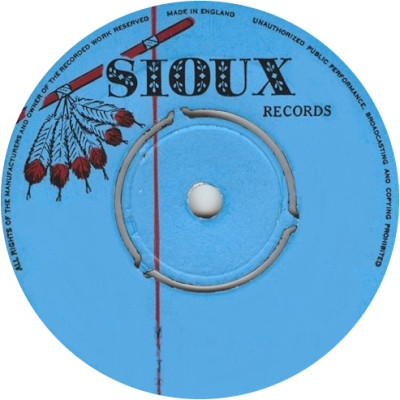
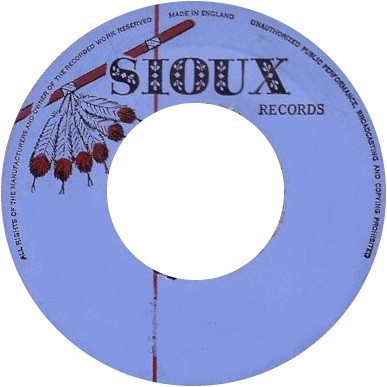
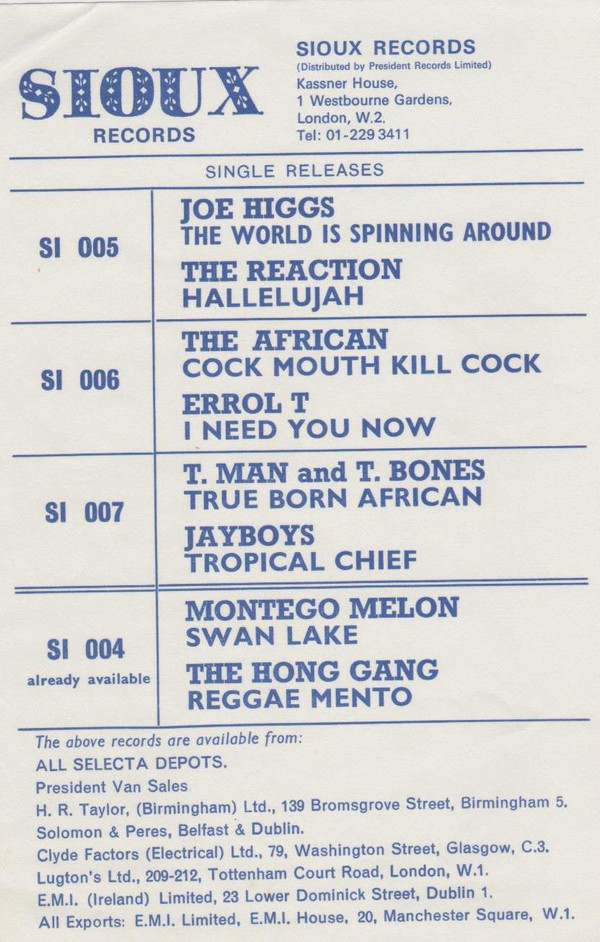
Sioux Records
0 releases
Britain major corporate record companies have rarely been able to market Jamaican music successfully. Ever since the first R&B 45s from Kingston crept out on Starlight (a subsidiary of [a=Carlo Krahmer]'s [l=Esquire] jazz label) and [l=Melodisc Records Ltd.] (an independent pop and jazz label owned by Emil Shalit) in the late Fifties, the big labels whose records dominated the pop charts had only sporadic success in their ventures into ska, rocksteady and reggae. Throughout the Sixties and into the Seventies, a myriad of small labels, run by individuals with personal knowledge of their specialised market, serviced the needs of their music hungry audience. Audience including, by the early seventies, young white "Suedeheads", the successor to the reggae-loving skinheads of two years earlier.
Nevertheless, two companies dominated the reggae scene. Both were independents working out of North London: [l=Trojan Records], with subsidiaries including Upsetter, [l=Big Shot], Harry J. and [l=Horse], and the Palmer brothers' Pama group whose imprints included [l=Crab], [l=Escort], [l=Bullet (3)] and [l=Unity (3)]. Between them they snapped up the rights to the majority of the hot new releases from Jamaica, and both companies scored substantial hits in the pop charts. This did not, of course, deter other labels from attempting to grab their slice of the pie.
Some were old-established: Melodisc had lost their former dominant position, but they were still a force to be reckoned with as they had exclusive rights to the output of top singer/producer [a=Prince Buster], and Rita and Benny King's [l=R&B (2)] Discs retained a slender silver of the market through their [l=Jolly (2)] and [l=Moodisc Records] labels. Others were hopeful young companies, such as [a=Junior Lincoln]'s Bamboo Records which, via their [l=Bamboo], [l=Ackee] and [l=Banana (2)] labels, issued new product from the mighty Studio One, and [a=Eddy Grant]'s [l=Torpedo] outfit. Grant was the leader of mixed-race pop group [a=The Equals] who had achieved considerable success in the late Sixties with hits like 'Baby Come Back' on the indie [l=President Records] label run by [a=Edward Kassner]. President had flirted briefly with reggae on their [l=Jay Boy] subsidiary in 1969; by 1971, with the Equals run of hits at an end, they were keen to explore new markets and decided to take a reggae label on board once more. That label was the fledging Sioux Records.
The infant had a good pedigree. Its founders were [a=Graham Goodall], an Australian who had worked as a studio engineer in Kingston before coming to England where he had run the legendary ska labels [l=Doctor Bird] and [l=Rio (2)], and the [l=Pyramid (2)] label which scored Britain's first Jamaican-recorded number one hit with [a=Desmond Dekker]'s Israelites, and was fresh from a stint at Melodisc, where he had been active as label manager, producer and musician for the [l=Fab] label, and had also been involved in independent production work. Sioux quickly established a lively and imaginative release policy, Jamaican sides from noted producers [a=Arthur "Duke" Reid] and Barry Johnson jostled in its schedule with tracks leased from respected Brixton-based producer [a=Joe Mansano], and in house production which often featured Jack Price under an alias. In its year of life, Sioux issued the impressive total of 25 singles and four LPs an output which included some very fine reggae music.
Notes by: [a=Mike Atherton]
FILTER
All Artists
All Labels
No records from this label currently in stock. Check back soon!
| PRICE | Image | Title | Artist | Genre | Style | Label | Year | Country | Format | Condition | Comment | |
|---|---|---|---|---|---|---|---|---|---|---|---|---|
| No records from this label currently in stock. Check back soon! | ||||||||||||
No records from this label currently in stock. Check back soon!
1-0 of 0