Loading...
North American Phonograph Company
0 releases
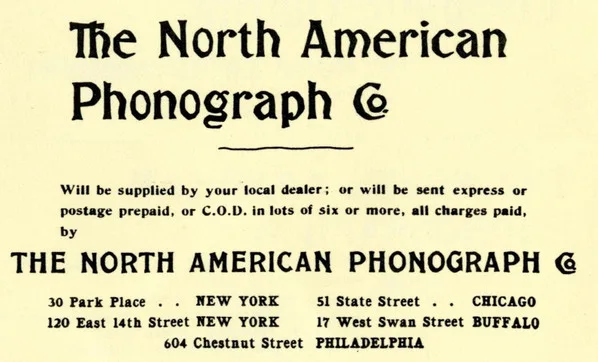
The [b]North American Phonograph Company[/b] ([b]NAPCo[/b]) was one of the first US record labels and audio equipment distributors, established in July 1888 by Jesse Harrison Lippincott (1843—1894) and headquartered in New York City. Amidst the "war of formats" between [a=Thomas Alva Edison] (1847—1931) and his [i]phonographs[/i] against [a=Alexander Graham Bell] (1847—1922) with [i]graphophones[/i], NAPCo struggled with constant legal and patent disputes, forced into bankruptcy and takeover by Thomas Edison. With activities ceased by mid-1894, the corporation was superseded by Edison's [b][i][l=National Phonograph Company][/b][/i] and formally dissolved in June 1898.
In the summer of 1888, when Jesse Lippincott from Pennsylvania established his [i]North American Phonograph Company[/i], he was initially interested in business dictation. Inspired by Bell Telephone's rapid growth, he envisioned NAPCo as an exclusive distributor renting recorders to local clients via regional providers. Lippincott decided to support two emerging technologies present on the market — "graphophones" from the [b][i][l=American Graphophone Company][/i][/b] launched in March 1887 and "phonographs" by [b][i][url=https://discogs.com/label/112017]Edison Phonograph Company[/url][/i][/b] incorporated in October 1887 — and secured exclusive contracts to market both types of devices and "special extras" (i.e., music recordings on cylinders). For some reason, Thomas Edison failed to inform NAPCo about the second, earlier patent holder, [i][b]Edison Speaking Phonograph Co.[/b][/i], based in Connecticut, which purchased his original "tinfoil-wrapped" cylinder method back in 1878. Once NAPCo began advertising, the Speaking Phonograph Co. suddenly threatened legal action, claiming exclusive rights for any technology derivatives. Lippincott and his board of directors decided to settle out of court in October 1888 to avoid negative publicity. By early 1889, as over 30 regional providers joined the network, NAPCo began sinking into debt, further extending bank credits and selling stock at a significant loss.
In February 1890, Thomas Edison's latest enterprise, the [b][i]Automatic Phonograph Exhibition Company[/b][/i], entered the market with jukebox-style phonographs with coin slots. Lippincott recognized a more lucrative business opportunity and signed another license agreement with Edison. His seemingly wise "format-agnostic" approach now backfired as NAPCo still had to order at least 5,000 devices annually at $100,000 from the [l=American Graphophone Company] per the exclusive contract. In May 1891, [i]North American Phonograph Co.[/i] went into general assignment, unable to cover Bell's royalties and Edison's equipment bills. Lippincott stepped down, replaced by [b]Samuel Insull[/b] (1859—1938) as president, while Edison joined the board of directors. He became NAPCo president in July 1892, gradually increasing sales and improving the financial position.
The newfound success didn't last even two years, when [b][i]Edison United Phonograph Co.[/b][/i], a joint corporate entity established in 1890 between Bell and Edison to market both phonographs and graphophones outside the USA/Canada, won the injunction against NAPCo in November 1893 for unauthorized UK sales. Thomas Edison stepped down as president in January 1894; three months later, Jesse Lippincott died, freeing Alexander Bell from his exclusive distribution contract and allowing the [i][l=American Graphophone Company][/i] to sell their product directly. In August 1894, NAPCo failed to pay creditors and went into insolvency; Thomas Edison tried to buy out the company to recover his patents, but other debtors intervened. The following year, Alexander Bell acquired the [b][i][l=Columbia Phonograph Company][/i][/b], one of NAPCo's leading regional subdivisions. In January 1896, the bankruptcy court finally approved the [i]North American[/i] buyout, and Thomas Edison transferred all patents to a new [b][i][l=National Phonograph Company][/b][/i], immediately countersuing American Graphophone and Columbia. After a year in court, Bell and Edison finally settled their dispute in December 1896 by mutually cross-licensing patents.
FILTER
All Artists
All Labels
No records from this label currently in stock. Check back soon!
| PRICE | Image | Title | Artist | Genre | Style | Label | Year | Country | Format | Condition | Comment | |
|---|---|---|---|---|---|---|---|---|---|---|---|---|
| No records from this label currently in stock. Check back soon! | ||||||||||||
No records from this label currently in stock. Check back soon!
1-0 of 0