
Loading...
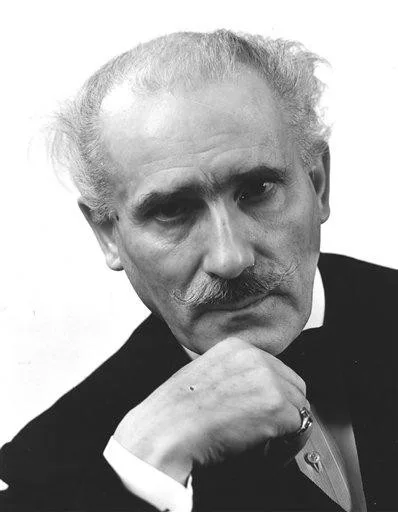
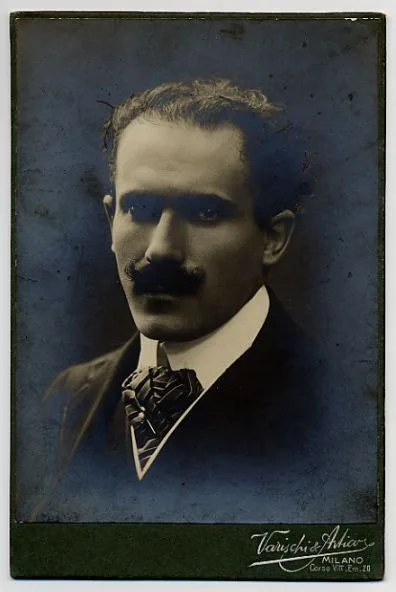
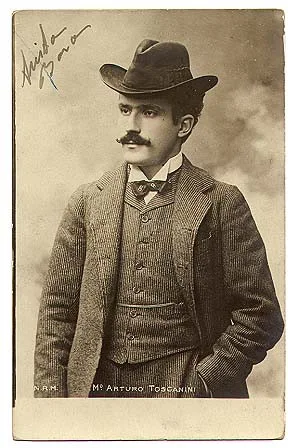
Arturo Toscanini
Arturo Toscanini (25 March 1867, Parma — 16 January 1957, New York, USA) was a distinguished Italian conductor often cited among the greatest maestros of the late XIX—early XX century. He was the father of choreographer [a=Walter Toscanini] (1898—1971) and [url=https://discogs.com/artist/2063739]Wanda Toscanini[/url] (1907—1998), who later married pianist [a=Vladimir Horowitz], and grandfather of architect [a=Walfredo Toscanini] (1929—2011) and photographer [url=https://discogs.com/artist/4195074]Sonia Toscanini Horowitz[/url] (1934—1975).
Toscanini began as a cellist, studying under Carini Severino Leandro (1834—1910) and [a=Giusto Dacci] (1840—1915) on a scholarship at [url=https://discogs.com/label/3093316]Parma Conservatory[/url]. In June 1886, shortly after graduation, 19-year-old Arturo had a highly unorthodox debut at the rostrum. He just became a principal cellist and assistant choirmaster for a new opera company established by Italian set designer and architect Claudio Rossi (1850—1935), who primarily worked as South American tour contractor for leading European troupes. Amidst his ill-fated premiere tour, Rossi's principal conductor [a=Leopold Amérigo Miguéz] resigned right before [url=https://discogs.com/artist/192327]Verdi[/url]'s [i]Aida[/i] performance in São Paulo; since neither the assistant conductor nor choirmaster could replace him, teenager Toscanini agreed to be a stand-in. Despite his young age, Toscanini excelled and decided to pursue this newly-founded path in favor of cello upon returning to Italy. In November 1886, Arturo gave his "home" debut at [url=https://discogs.com/label/2030610]Teatro Carignano[/url] in Turin, conducting the world premiere of [a=Alfredo Catalani]'s [i]Edmea[/i] opera. From 1898 to 1908, Toscanini was a principal conductor at [l=Teatro alla Scala, Milano].
Between 1908 and 1915, he resided in the USA, employed at [b][l=The Metropolitan Opera House][/b] in New York. In December 1920, on tour with [url=https://discogs.com/artist/841593]La Scala Orchestra[/url], Toscanini made his first acoustic recordings for at [url=https://discogs.com/label/2229562]Camden Church Studio[/url] in New Jersey, featuring works by [url=https://discogs.com/artist/95546]Mozart[/url], [url=https://discogs.com/artist/95544]Beethoven[/url], [url=https://discogs.com/artist/855775]Pizzetti[/url], and [url=https://discogs.com/artist/526594]Respighi[/url] that came out as a series of 78 RPM shellac discs. Besides a few early releases on other gramophone labels, such as [l=Fonotipia], [l=Brunswick Record Corporation], and [l=The Gramophone Co. Ltd] / [l=His Master's Voice], Toscanini exclusively recorded for [b][l=RCA Victor][/b] for his entire career.
In 1926, Toscanini began conducting the [b][a=New York Philharmonic][/b], extensively touring the US and Europe for most of the decade. Under the guidance of the orchestra's press manager, [a=Dorle J. Soria] (who later co-founded [l=Angel Records] with her husband), the maestro rapidly grew to international superstardom. Despite his brief early support for [a=Benito Mussolini], Toscanini was a fervent critic of the fascist regime and persistently refused to open concerts with the "[i]Giovinezza[/i]" hymn. In turn, Mussolini quickly went from praising "the greatest conductor in the world" to ignoring even such iconic La Scala premieres as [url=https://discogs.com/artist/369053]Puccini[/url]'s [i]Turandot[/i] in April 1926. Their tensions peaked by the early 1930s after Toscanini's historical appearance at as the first non-German maestro. In May 1931, Blackshirts sabotaged his [l=Teatro Comunale di Bologna] concert, physically assaulting Arturo and his wife. They immediately fled the country, narrowly escaping only thanks to the bravery of the event organizer, [a=Cesare Nordio] (1891—1977), and [a=Ottorino Respighi]'s timely protection. Toscanini appeared at the [url=https://discogs.com/label/365596]Salzburg Festival[/url] (1934 to 1937) and led the [url=https://discogs.com/artist/837568]Palestine Symphony Orchestra[/url]'s inaugural 1936 concert in Tel Aviv.
In 1936, Toscanini resigned from NY Phil and returned to Italy, planning to retire at 69. Soon, the [url=https://discogs.com/label/265984]RCA[/url] president [a=David Sarnoff] (1891—1971) offered him to lead a new radio broadcast symphonic orchestra in the States. Hesitant at first, Arturo agreed — convinced by their mutual friend, pianist [a=Samuel Chotzinoff] (1899—1964). In December 1937, Toscanini debuted with a newly established [b][a=NBC Symphony Orchestra][/b]. His third US tenure lasted for 17 years and was most illustrious, with Toscanini eventually recognized as a nationwide household name. He left the stage at 87 after suffering a transient ischemic attack during a [l=Carnegie Hall] concert in April 1954.